Why Your Dog Seems More Tired After a Shorter Walk Than Usual Lately
Quick Answer: A shorter walk producing more fatigue usually means something about the walk’s intensity, terrain, temperature, or mental stimulation was higher than usual, not that the shorter distance itself was more tiring — dogs, like people, respond to exertion intensity and environmental demand, not just distance covered.
A handful of specific factors explain most of these mismatches between distance and how tired a dog seems afterward.
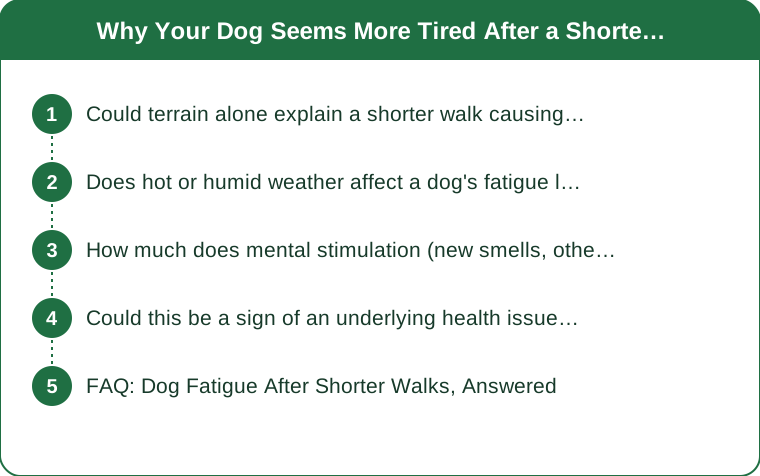
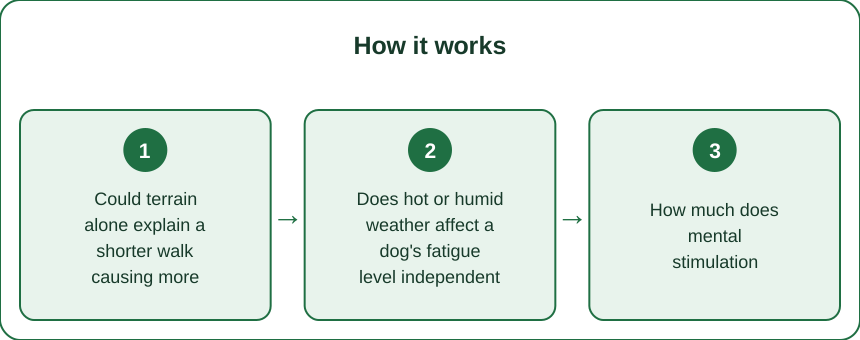
Could terrain alone explain a shorter walk causing more fatigue?
Yes — walking on sand, uneven trail, or a route with more inclines demands significantly more muscular effort per step than a flat sidewalk route of the same length, so a shorter but more physically demanding route can genuinely produce more fatigue than a longer flat one.
Does hot or humid weather affect a dog’s fatigue level independent of walk length?
Heat and humidity make thermoregulation itself metabolically costly for dogs (who cool primarily through panting, a less efficient mechanism than human sweating), so a shorter walk on a hot, humid day can be considerably more taxing than a longer walk on a cool day — this is one of the most common explanations for this exact pattern.
How much does mental stimulation (new smells, other dogs, unfamiliar routes) factor into physical tiredness?
Mental engagement is genuinely tiring in its own right — a walk through a new environment with unfamiliar scents and stimuli requires more cognitive processing than a familiar route, and this mental fatigue often manifests as physical tiredness and a need to rest afterward, sometimes more so than the physical distance covered.
Could this be a sign of an underlying health issue rather than an environmental explanation?
If unusual post-walk fatigue is a new, persistent pattern rather than a one-off, or is accompanied by other changes (limping, reduced appetite, labored breathing), it’s worth a vet visit — occasional variation tied to heat, terrain, or a novel route is normal, but a consistent new pattern deserves a closer look.
FAQ: Dog Fatigue After Shorter Walks, Answered
Should I be worried if this only happened once?
A single instance, especially if it lines up with heat, unfamiliar terrain, or a particularly stimulating environment, is not typically a cause for concern on its own.
Does age make dogs more susceptible to this kind of fatigue mismatch?
Older dogs and those with underlying joint issues often show a bigger gap between distance and fatigue level than younger, healthier dogs, since terrain and heat place proportionally more strain on a body already managing some wear.
Is it fine to just let my dog rest more after a walk like this?
Yes — extra rest after a more demanding (even if shorter) walk is a completely appropriate and healthy response, similar to how a person might need more recovery after a harder workout regardless of its length.
TL;DR:
- Distance alone doesn’t predict fatigue — terrain, heat, and mental stimulation matter more
- Uneven terrain and inclines demand more effort per step than flat routes
- Heat and humidity make cooling itself metabolically costly for dogs
- A new, persistent pattern (versus a one-off) is what actually warrants a vet visit
This is general information, not veterinary advice — a persistent or worsening pattern is worth a vet check.
Keep Reading
This article is for general informational and styling purposes only. Fit, sizing, and product availability may vary.