How to Tell if Your Dog Is Actually Fit or Just Thin
Quick Answer: Assess four things rather than weight: body condition score by feel (ribs easily felt under a thin fat layer, visible waist from above), recovery rate after exertion (breathing normal within about two minutes of stopping), functional strength (hind-end control on stairs and inclines), and endurance consistency across a walk. A thin dog with poor recovery and a weak hind end is not fit.
The distinction matters because thinness and fitness respond to completely different interventions.

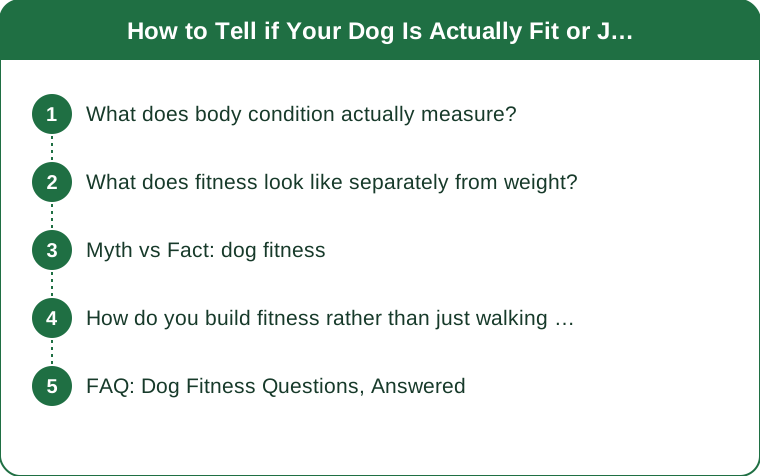
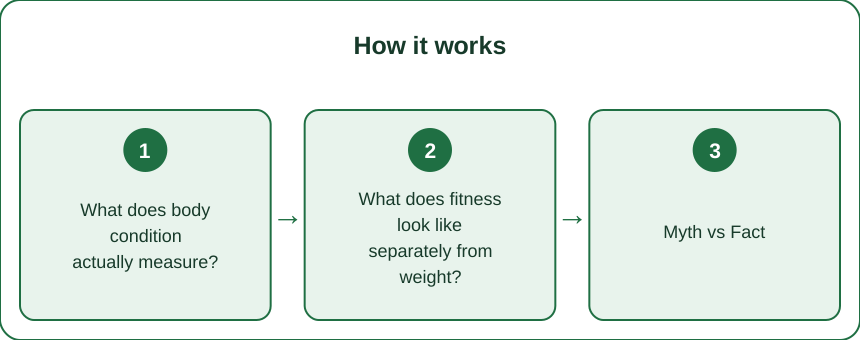
What does body condition actually measure?
Body condition score is a nine-point scale vets use, and you can assess it at home in about thirty seconds.
The rib test. Run your hands flat along the sides of the chest. You should feel the ribs easily, with a thin layer of covering — similar to feeling the back of your own hand. If you have to press to find them, the dog is carrying excess. If they feel like your knuckles with nothing over them, the dog is underweight.
The overhead view. Standing above your dog looking down, there should be a visible waist behind the ribcage. No waist means excess weight; a dramatic hourglass with visible hip bones means too little.
The side view. The abdomen should tuck up from the ribcage toward the hind legs. A straight or sagging line indicates excess.
Ideal is a 4 or 5 out of 9. The important context: studies consistently find that a majority of pet dogs in the US are above ideal, and owners consistently underestimate their own dog’s score. The dog you think is normal-sized is probably a 6.
But all of this measures composition, not capacity. A dog can score a perfect 5 and have very little conditioning.
What does fitness look like separately from weight?
Four observable markers, all of which you can check on an ordinary walk.
Recovery rate is the single best indicator. After a burst of hard activity — a run, a hill, a game of fetch — a well-conditioned dog’s breathing should settle noticeably within about two minutes of stopping. A dog still panting heavily after five minutes of rest, on a moderate day, is under-conditioned regardless of how it looks.
Hind-end strength. Watch your dog go up stairs or a steep incline. Does the back end drive, or does it pull with the front and drag behind? Hind-end weakness is extremely common, develops silently, and is the thing most likely to become a problem with age.
Consistency across duration. A fit dog’s pace and enthusiasm at minute forty look like minute ten. A dog that starts strong and drops off sharply after twenty minutes has endurance limits, not a behaviour problem.
Willingness to change gait. Fit dogs move fluidly between walk, trot, and canter. A dog that stays in one gait, especially one that will not trot, is often avoiding discomfort.

Myth vs Fact: dog fitness
Myth: A dog that is not overweight is fit. Fact: These are independent. Composition and conditioning are separate, and a lean, sedentary dog is a common and easily missed pattern — especially in dogs whose owners control diet carefully but exercise inconsistently.
Myth: Puppies and young dogs are automatically fit. Fact: Young dogs have energy and enthusiasm, which masks poor conditioning. They also should not do sustained high-impact exercise while growth plates are open — typically until 12-18 months depending on breed size. Enthusiasm is not a green light.
Myth: A long daily walk is enough. Fact: Steady-state walking builds a base and does very little for strength or power. A dog that only ever walks at one pace on flat ground has no hind-end strength development at all. Add hills, add varied surfaces, add short bursts.
Myth: Breed determines how much exercise a dog needs. Fact: Breed sets a rough range, and individual variation within a breed is enormous. Assess the dog in front of you rather than the breed description.
Myth: If they are keen to keep going, they are fine. Fact: Many dogs, particularly working breeds, will run past the point of harm. Enthusiasm is the least reliable stopping signal there is, and this matters most in the heat.
How do you build fitness rather than just walking more?
Progression, variety, and recovery — the same principles as human training, on a shorter timeline.
Add hills before adding distance. Incline work builds hind-end strength faster than anything else available for free. Five minutes of hill repeats on a normal walk does more than an extra mile of flat.
Vary the surface. Grass, sand, gravel, and woodland trails demand more stabiliser work than pavement. Sand in particular is excellent conditioning and should be introduced gradually because it is demanding.
Add short bursts. Two or three 20-30 second faster sections in a walk develop capacity that steady walking never touches.
Increase by about 10% a week. The same rule that governs human running injury applies. Going from a 30-minute walk to a two-hour hike on Saturday is where soft-tissue injuries come from.
Include rest days. Dogs need recovery, and back-to-back hard days without it produce the same overuse patterns seen in people.
Late summer caution: through late August the ground stays hot well after the air has cooled, and pavement that is comfortable for shoes can burn paw pads. Press the back of your hand to the surface for seven seconds — if you cannot hold it, neither can they. Early morning and after sunset remain the right windows until the pavement genuinely cools in September. This is general information, not veterinary advice — a dog with a sudden change in stamina, gait, or breathing should see a vet.
FAQ: Dog Fitness Questions, Answered
How do I check body condition on a very fluffy dog?
By feel only. Coat makes the visual assessment useless on double-coated and long-haired breeds, and it is exactly these dogs whose weight gain goes unnoticed longest. Hands on the ribs and the waist, every couple of weeks.
My dog is older — should I stop conditioning work?
No, adjust it. Senior dogs lose muscle mass rapidly without stimulus, and hind-end weakness is the main driver of mobility loss. Shorter, more frequent sessions with gentle inclines maintain far more than rest does. Check with your vet first if there is any known joint condition.
How long does it take to see a fitness change?
Recovery rate usually improves within two to three weeks of consistent varied work — often before any visible change in shape. It is the marker to track, because it moves first.
TL;DR:
- Weight and fitness are independent: assess body condition by feel, then assess conditioning separately.
- Recovery rate is the best single fitness marker — breathing should settle within about two minutes after exertion.
- Watch hind-end drive on stairs and hills; weakness there develops silently and matters most with age.
- Steady flat walking builds almost no strength — add hills, varied surfaces, and short bursts.
- Progress by about 10% a week, include rest days, and check pavement heat with the back of your hand in late summer.
The dog most likely to be missed is the lean one that never does anything demanding. This is general information, not veterinary advice.
Keep Reading
This article is for general informational and styling purposes only. Fit, sizing, and product availability may vary.