Your Dog Needs a Warm-Up Too - Here Is What It Looks Like
Quick Answer: Dogs need a warm-up for the same reasons we do - cold muscle and tendon are stiffer, less extensible and more injury-prone, and the first minutes of activity are when soft-tissue injuries happen. A useful warm-up is five minutes of easy walking, then two minutes of gentle movement variety - a few slow circles each direction, a couple of gentle sit-to-stands, some easy direction changes - before anything fast. This matters most for the explosive activities: fetch, sprinting after another dog, and stairs. It matters more in late August than it did in July, because mornings are now genuinely cool.
We are careful about our own warm-ups and completely inconsistent about theirs. The door opens, the ball comes out, and a dog that was asleep ninety seconds ago is at a full sprint with a hard turn at the end of it.
That is the exact scenario that produces soft tissue injuries, and it happens in the first two minutes of the outing rather than the last.
The fix is five minutes and no equipment - and right now, with mornings dropping into the 50s, it matters more than it did a month ago.
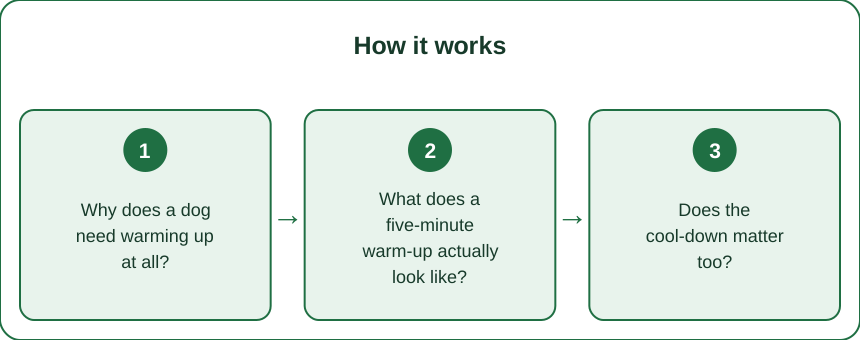
Why does a dog need warming up at all?
The same tissue physiology applies. Dogs are not exempt because they seem enthusiastic.
Cold muscle is stiffer and less extensible than warm muscle, and stiff tissue tears at lower loads. Warming raises tissue temperature, increases blood flow, and improves the elasticity of muscle and tendon - which is why warm-ups reduce strain injuries across species.
The complication with dogs is that enthusiasm masks readiness completely. A dog that has been lying down for two hours will still launch into a full sprint the instant a ball appears, because motivation and tissue readiness are entirely separate systems. There is no equivalent of the human experience of the first minute feeling stiff and choosing to ease in. They simply go.
The common injuries this produces are worth naming:
- Iliopsoas strain - a hip flexor injury, very common in dogs that make hard accelerations from a stand
- Cranial cruciate ligament injuries - the canine equivalent of an ACL tear, frequently associated with sudden twisting or a hard turn
- Shoulder soft tissue injuries - common in dogs that brake hard or land awkwardly from a jump
- General muscle strains, especially in the hind limbs
Which dogs are most at risk: older dogs, dogs carrying extra weight, long-backed breeds, dogs coming off a period of rest, and - the one people forget - very fit dogs, because they can generate more force and reach higher speeds faster than their cold tissue is ready for.
What does a five-minute warm-up actually look like?
Simple, unglamorous, and it takes less time than finding the lead.
Minutes 1 to 3: easy walking on lead. Not sniffing-and-stopping, just relaxed continuous forward movement. This raises core temperature and gets blood into the working muscles. Loose lead, no pulling drills, nothing structured.
Minute 4: gentle direction changes. Walk a few large, slow figure-eights or gentle curves in both directions. This introduces lateral movement and rotation gradually rather than the first turn of the day being a hard cut at speed after a ball.
Minute 5: a small amount of movement variety.
- Three or four slow sit-to-stands. Loads the hind limbs through range under control - the canine equivalent of bodyweight squats.
- A few gentle circles each way, encouraged with a treat at nose level, so the spine and hind limbs move laterally.
- A short walk over uneven ground if available - grass, a gentle slope - to wake up proprioception and stabilising muscles.
Then build intensity over the first few minutes rather than starting at maximum. If you are running with your dog, start at a walk and ease into it. If you are throwing a ball, make the first three throws short and low so there is no sprint-and-hard-brake.
Things to specifically avoid cold: the first ball throw being a long one, stairs immediately on leaving the house, jumping into a car boot, and any tug game before the dog has moved. All four are high-load activities from a standing start.
Does the cool-down matter too?
Less than the warm-up, and it is not nothing.
Three to five minutes of easy walking after hard activity helps clear metabolic byproducts and lets heart rate and breathing return to baseline gradually. Practically, it also stops the pattern of a dog going from full sprint to lying on a cold kitchen floor within ninety seconds, which is when stiffness sets in.
Do not stretch your dog. This is worth saying plainly. Passive stretching of a dog’s limbs by an owner is easy to do badly, dogs cannot tell you when a stretch is too much, and there is real potential to overextend a joint. Gentle movement, yes. Manual stretching, only if a veterinary physiotherapist has shown you specifically how.
Watch the surface temperature on the way home. Late August is exactly when people relax about pavement, and it is still warm enough in the afternoon to matter even though mornings are cool. The back of your hand held on the ground for seven seconds remains the simplest test there is.
And watch for stiffness later, not just during. Soft tissue injuries in dogs frequently show up as a subtle change hours afterwards or the next morning - reluctance on stairs, slower to get up, a shortened stride, sitting in an unusual position. A dog that seemed fine during the walk and is stiff the next morning has told you the session was too much, and that is information worth acting on rather than watching for another week.
What Nobody Tells You About Warming Up a Dog
Enthusiasm is not readiness, and this is the whole problem. Your dog will always seem ready. That is a temperament signal, not a physiological one, and it is why owners consistently skip the warm-up - the dog appears to be arguing against it.
The dog park is the highest-risk five minutes of the week. Arrive, gate opens, immediate full-speed chase with hard turns on grass, from completely cold. It is the single most common setting for the injuries described here. A five-minute walk around the outside of the park before going in costs nothing and changes the picture entirely.
Fetch is more dangerous than running. Running is steady-state and self-paced. Fetch is repeated maximal acceleration, hard braking and turning - and dogs will not self-regulate for fatigue when a ball is involved. The last three throws of a long fetch session are where injuries cluster, because the dog is fatigued and still going at full effort.
Cool mornings change the requirement. A 55F morning needs a longer warm-up than an 80F one, and this is exactly the transition happening right now. If your routine was calibrated in July, it is now too short.
Older dogs need longer, not less. The instinct is to do less with a senior dog, and the more useful adjustment is a longer warm-up with a gentler main activity. Reduced activity plus a cold start is the worst combination for an older dog.
And a warm-up is not extra time. It is the first five minutes of a walk you were doing anyway, walked slightly slower.
FAQ: Dog Warm-Up Questions, Answered
How do I know if my dog has strained something?
Look for changes rather than obvious limping - a shortened stride, reluctance on stairs or jumping into the car, slower to rise after resting, sitting with a leg out to one side, or licking at one area repeatedly. Many soft tissue injuries do not produce dramatic limping and are easy to miss for days. Anything that persists more than 24 to 48 hours, or any obvious lameness, is a vet visit rather than a wait-and-see.
Does my dog need a warm-up for an ordinary walk?
Not a formal one. An ordinary walk begins at walking pace, which is the warm-up. The warm-up matters when the activity starts intense - fetch, running, dog park chase, agility, or anything explosive from a standing start. If the first two minutes are already low intensity, you are covered.
Is it different for puppies?
Yes, and mostly in a different direction. Puppies have growth plates that have not closed and are more vulnerable to joint stress from repetitive high-impact activity, so the priority for a puppy is limiting intensity and duration overall rather than warming up for hard exercise. Repeated fetch, long runs on hard surfaces, and jumping should be limited for young dogs - your vet can advise based on breed and expected size.
This is general information, not veterinary advice. Any suspected injury, persistent lameness, or change in your dog’s movement should be assessed by a veterinarian.
TL;DR:
- Cold tissue is stiffer and injures more easily - in dogs as in us, and the first two minutes are the risk window.
- Five minutes: three of easy walking, one of gentle curves, one of slow sit-to-stands and circles.
- Enthusiasm is not readiness. Your dog will always seem ready to sprint, and that tells you nothing about tissue temperature.
- Fetch and the dog park are the highest-risk activities - repeated acceleration and hard turns from cold.
- Do not manually stretch your dog. Gentle movement only, unless a veterinary physio has shown you how.
Cooler mornings are here, which means the warm-up your routine had in July is now too short. It is the first five minutes of a walk you were doing anyway.
Keep Reading
This article is for general informational and styling purposes only. Fit, sizing, and product availability may vary.