Why Late Summer Heat Still Catches Dog Owners Off Guard
Quick Answer: Late summer catches people out because the calendar says the season is ending while the ground is at its hottest. Pavement retains accumulated heat and can sit 40 to 60 degrees above air temperature, humidity often stays high, dogs are less heat-acclimated than owners assume after a summer of air conditioning, and the earlier sunset shifts walks into hours that feel cooler than they are. Check pavement with the back of your hand for seven seconds before every walk.
It is 79 degrees and breezy at 6pm and it genuinely feels like fall is coming. Your dog is walking on a surface that is still holding this afternoon’s heat.
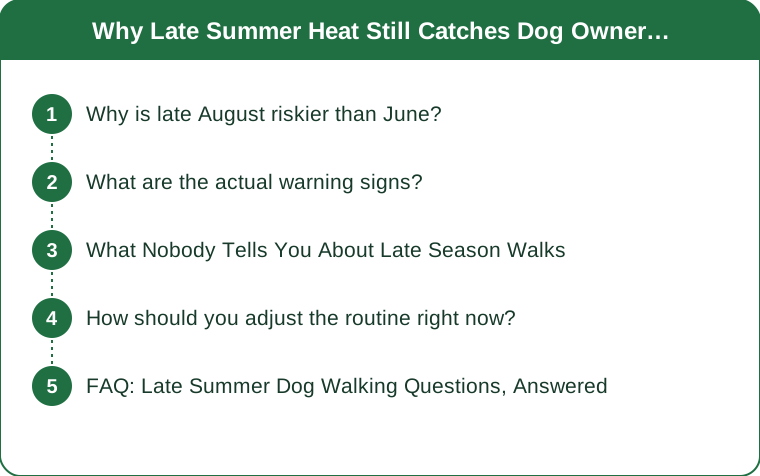
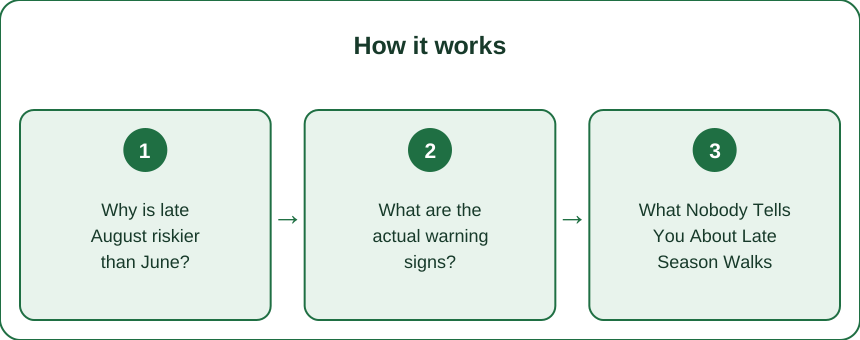
Why is late August riskier than June?
Four things line up, and the calendar hides all of them.
Ground heat accumulates over a season. Asphalt and concrete store heat across consecutive hot days and release it slowly. By late August, surfaces are working from a much higher baseline than they were in early summer. Asphalt can reach 125 degrees when the air is 77, and considerably more on a sunny afternoon - hot enough to damage paw pads within about a minute.
Humidity often stays high while air temperature drops. Dogs cool primarily by panting, which is evaporative. High humidity reduces panting efficiency, so a humid 80-degree day is harder on a dog than a dry 88-degree one - and humidity commonly persists into late summer.
People relax. June brings visible caution because the heat is new. By late August the vigilance has worn off, and so has the novelty that produced it.
Sunset moves earlier. The evening walk that happened in full daylight in June now happens closer to dusk, which feels cooler while the ground is still radiating heat from an afternoon you did not experience.
What are the actual warning signs?
Know these properly, because the early ones are easy to read as ordinary tiredness.
Early signs: heavier panting than the activity warrants, seeking shade or stopping, slowing down, excessive drooling, and bright red gums or tongue. A dog that lies down and will not continue is not being stubborn - that is a signal and it deserves an immediate response.
Progressing signs: thick, ropey saliva, unsteadiness, glazed eyes, vomiting or diarrhea, and a rapid heart rate. At this point the walk is over and cooling is the only priority.
Emergency signs: collapse, seizures, or unresponsiveness. This is a veterinary emergency, not a wait-and-see situation.
What to do: move to shade or indoors, offer cool - not ice-cold - water, and wet the belly, groin, armpits, and paw pads with cool water where the blood vessels are close to the surface. Do not use ice or ice water, which can constrict surface vessels and slow overall cooling. Call your vet.
Higher risk dogs: flat-faced breeds, seniors, puppies, overweight dogs, thick-coated breeds, and any dog with heart or respiratory conditions. These need a considerably more conservative threshold than a fit young dog does.
What Nobody Tells You About Late Season Walks
Your dog is less heat-acclimated than you think. A summer spent mostly in air conditioning means limited adaptation. A dog that has been indoors for weeks is not conditioned for an 80-degree walk simply because it is August.
Grass is not automatically safe. Shaded grass is meaningfully cooler than pavement, but sun-exposed artificial turf can be hotter than asphalt - a genuinely surprising number that catches out people who deliberately avoid sidewalks.
Short walks in heat can be worse than long ones in cool. A 15-minute walk on 130-degree pavement does more damage than an hour on cool ground. Duration is not the risk factor people think it is - surface temperature is.
Dogs do not self-regulate reliably. Many dogs, particularly retrievers and herding breeds, will keep going well past the point where they should stop. Willingness to continue is not evidence that continuing is safe.
Booties help paws, not temperature. They protect from surface burns and do nothing for core temperature - and some dogs get warmer in them because paw pads are a minor cooling surface. Useful tool, narrow purpose.
Water alone is not enough. Drinking helps, but a dog cooling by panting in humid air is fighting physics. Shade and reduced activity do the actual work.
How should you adjust the routine right now?
Small changes, applied consistently for the next few weeks.
Use the seven-second hand test, every time. Place the back of your hand on the pavement. If you cannot hold it comfortably for seven seconds, it is too hot for paws. This takes ten seconds and replaces all guessing.
Move the main walk to before 9am. Ground temperature is at its daily low in the early morning after overnight cooling. Evening walks feel cooler to you and often are not cooler underfoot, because the surface has been absorbing heat all day.
Shift the exercise, do not cancel it. Sniff walks on grass, indoor training games, a hallway fetch session, and puzzle feeders all provide genuine stimulation. Twenty minutes of scent work tires most dogs comparably to a much longer walk, and it happens in air conditioning.
Carry water and offer it before your dog asks. Every 15 minutes on any warm walk, whether or not they seem interested.
Watch the humidity, not just the temperature. A simple guide: if air temperature in Fahrenheit plus relative humidity exceeds roughly 150, be cautious with any sustained activity. It is imprecise but far more useful than temperature alone.
Never leave a dog in a parked car. At 80 degrees outside, interiors reach dangerous levels within minutes, cracked windows included.
FAQ: Late Summer Dog Walking Questions, Answered
Is a wet towel or cooling vest worth it?
Cooling vests help when they stay damp and there is airflow - they work by evaporation, so in very humid conditions the benefit shrinks considerably. A wet towel to lie on afterward is genuinely useful and much cheaper.
How do I know if my dog is just tired versus overheating?
Tired dogs slow down and recover with a short rest in shade. Overheating dogs pant hard without settling, have bright red gums, and do not recover with a few minutes of rest. If a few minutes in shade does not visibly settle the breathing, treat it as heat stress.
Does shaving a double-coated dog help them stay cooler?
Generally no, and it can make things worse - the undercoat provides insulation against heat as well as cold, and shaving removes sun protection. Regular brushing to remove loose undercoat is the better approach. Ask your vet or groomer about your specific breed.
When will it actually be safe to return to normal walks?
Watch the surfaces rather than the calendar. Once overnight lows drop enough that pavement passes the hand test in the evening, normal routines resume - typically a few weeks after the air starts feeling like fall.
This is general information, not veterinary advice. Talk to your vet about your dog’s specific needs.
TL;DR:
- Late summer is riskier than early summer because ground heat has accumulated all season while owner vigilance has faded.
- Pavement can sit 40 to 60 degrees above air temperature - use the seven-second back-of-hand test before every walk.
- Humidity matters as much as temperature, because panting is evaporative cooling and humid air blunts it.
- Shift walks to before 9am, swap in scent work and indoor games, and know the early signs: heavy panting, shade seeking, bright red gums.
The reason this stretch of the year catches people out is that everything about it signals the danger has passed - shorter days, cooler evenings, a general sense that summer is wrapping up. The pavement has not read the calendar, and for the next few weeks it is still the hottest thing your dog touches all day.
Keep Reading
This article is for general informational and styling purposes only. Fit, sizing, and product availability may vary.