Rainy Day, Restless Dog: Indoor Exercise for the Weather-Stranded
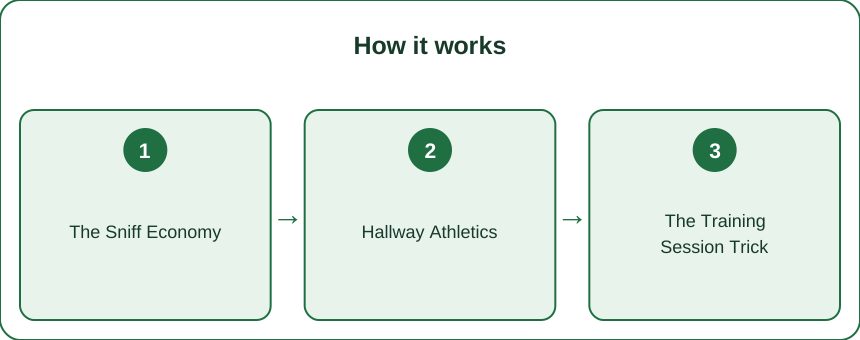
Quick Answer: Ten minutes of nose work tires a dog roughly as much as thirty minutes of walking, because sniffing is cognitively expensive. On a rained-out day, combine two short sniff games, ten minutes of hallway fetch or tug with rules, and a ten-minute trick-training session. Mental work beats mileage for burning canine energy indoors.
Rain reveals the truth about your dog’s energy budget. Unspent, it converts directly into couch destruction and 9pm hallway zoomies at approximately the speed of sound.
Indoor exercise is damage prevention with a leash on it. And the useful news is that the best indoor options tire dogs faster than the walk they replaced.

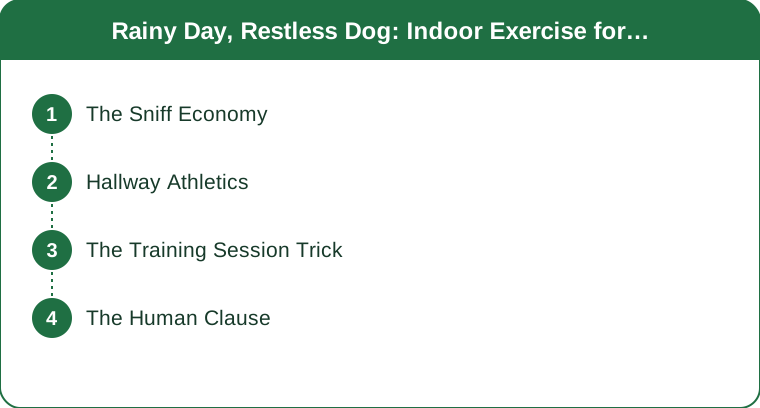
Why does sniffing tire a dog out so much?
Because scent work is genuinely hard cognitive labor. A dog’s olfactory system is enormous relative to ours, and running it at full capacity burns real mental energy — which is why 10 minutes of nose work leaves many dogs as settled as 30 minutes of walking.
Three sniff games, easiest first:
- Scatter feeding. Toss your dog’s kibble across a rug or a snuffle mat. Zero setup, works for every dog, and turns a 90-second meal into a 10-minute job.
- Hide the treats. Put your dog in another room, hide 5 to 10 treats at nose height around one room, then release them with a cue like “find it.” Start easy and make it harder as they figure out the game.
- The towel roll. Lay a towel flat, scatter treats on it, roll it up loosely. Your dog has to unroll it to win. Graduate to a tighter roll or a muffin tin with tennis balls over the treats.
Run 10 minutes of this and watch what happens over the following half hour. Most dogs go straight to sleep.
What indoor games actually burn physical energy?
Hallway fetch. Find the longest straight run in your home and use it. Ten focused minutes beats an hour of guilty eye contact from the sofa.
Stair fetch — with a caveat. Throw the toy up the stairs and let the dog run up and walk back down. This is only for young, healthy, structurally sound dogs; it’s hard on joints, and it’s a bad idea for puppies still growing, senior dogs, or any breed with known joint issues. Repeated hard landings coming down stairs are the problem, so send them up, not down.
Tug with rules. Tug is excellent exercise and completely fine for dogs, provided there’s structure: they sit to start, they release on cue, and the game restarts on your signal. That structure turns it into obedience practice with a cardio component.
The flirt pole. A rope toy on a stick, swung in circles. Enormous energy burn in a small space. Keep the turns wide and the sessions short — 5 minutes is plenty — because sharp turns are hard on joints.
Two ten-minute sessions beat one twenty-minute session. Dogs, like people, focus better in shorter blocks.

Does training count as exercise?
Absolutely — new tricks are treadmills for the brain.
Ten minutes teaching spin, touch (nose to your palm), place (go to a mat and stay), or tidy your toys leaves most dogs napping like they hiked a mountain. Learning something genuinely new is more tiring than repeating a known cue, so keep introducing new challenges rather than drilling sit for the fortieth time.
Structure a session like this: 2 minutes of easy known cues to warm up, 5 to 6 minutes on the new skill in short repetitions, 2 minutes of something they’re great at to end on a win.
The bonus is compounding: a rainy fortnight can genuinely produce a better-mannered dog. Bad weather is the best training season there is, largely because you’re both stuck inside anyway.
What Nobody Tells You About Indoor Dog Exercise
- A tired dog and an over-stimulated dog look identical for about ten minutes, then diverge sharply. If your dog gets more frantic after play, they need a settle routine, not another round.
- Frozen enrichment is the secret weapon. A stuffed and frozen rubber toy buys 20 to 40 minutes of quiet work. Prepare several in advance during rainy season.
- Traction matters more indoors than out. Hardwood and tile cause slips, and slips cause soft-tissue injuries. Put a runner or a couple of rugs down the fetch hallway.
- Some breeds need the mental work more than the physical. Working and herding breeds especially. A border collie who got a run but no job is still going to redesign your sofa.
- Half these games count as your workout too. Stair fetch climbs both parties, and floor play is squats in disguise. If you’re doing a rainy-day session in buttery soft high waist leggings rather than jeans, you’ll actually get down on the floor — which is where most of the good games happen.
How much indoor exercise does a dog need?
As a rough guide, aim to replace roughly two-thirds of the normal walk time, weighted toward mental work:
- Small or low-energy dogs: 20 to 30 minutes total, split into 3 sessions.
- Medium, average energy: 40 to 50 minutes total, split into 3 to 4 sessions.
- High-energy or working breeds: 60+ minutes total, plus at least two enrichment items.
Spread it across the day rather than front-loading it. A dog exercised only in the morning still has an evening to fill, and they will fill it.
FAQ
How do I tire out a dog without going outside?
Lead with scent work — 10 minutes of nose games does the work of about 30 minutes of walking. Add short bursts of hallway fetch or tug with rules, plus a 10-minute training session on something new.
Is stair fetch safe for dogs?
Only for young, healthy adult dogs without joint issues, and only sending them up the stairs while they walk down. Avoid it entirely for puppies, seniors, and breeds prone to hip or elbow problems.
My dog gets more hyper after indoor play. What’s wrong?
That’s usually over-arousal rather than under-exercise. Switch to lower-arousal activities — scent work, a frozen chew, a settle-on-mat routine — and end play before they hit peak excitement rather than after.
TL;DR:
- Sniffing is the cheat code: 10 minutes of nose work ≈ 30 minutes of walking.
- Hallway fetch, tug with rules and a flirt pole cover the physical side in small spaces.
- Ten minutes of teaching a new trick tires dogs like a hike, and buys you a better-mannered dog.
- Put rugs down — slips on hardwood cause real injuries.
- Spread it across 3 to 4 short sessions. Front-loading leaves the evening unfunded.
Keep Reading
This article is for general informational and styling purposes only. Fit, sizing, and product availability may vary.