Is Your Dog Actually Fit Enough to Run With You?
Quick Answer: Dogs will keep running well past their comfortable limit because the drive to stay with you overrides fatigue signals. The reliable indicators are recovery time (breathing back to normal within about ten minutes of stopping), gait quality late in the run, willingness the next day, and behaviour in the hours afterward. Build distance by roughly 10% per week, and do not run dogs whose growth plates have not closed.
Your dog looks delighted for the entire run and then cannot get comfortable all evening.
That is the core problem with running with dogs: the feedback you get during the activity is unreliable, and the useful signals arrive afterward.
This is general information, not veterinary advice. Discuss an exercise plan with your vet, particularly for young, older, or brachycephalic dogs.
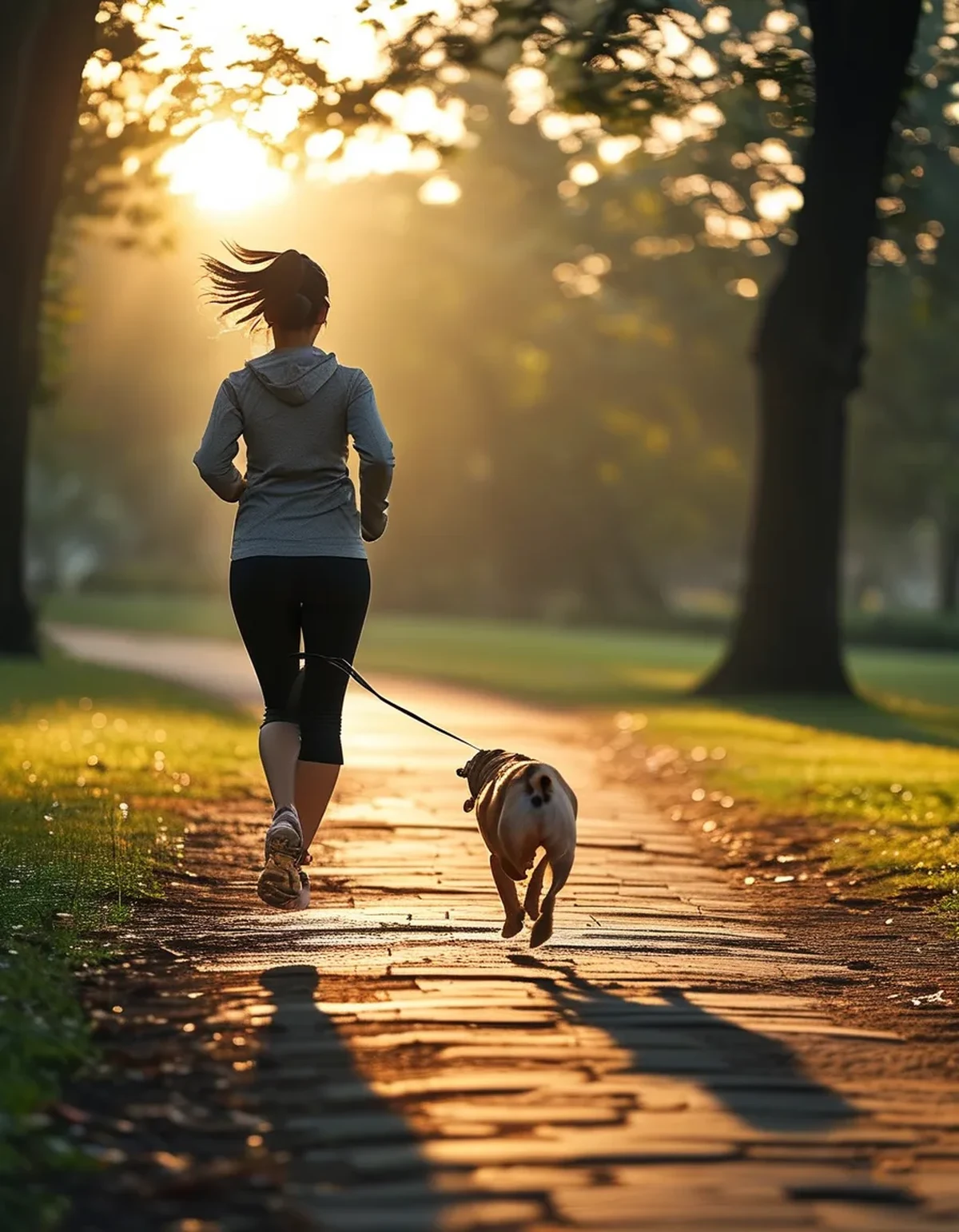
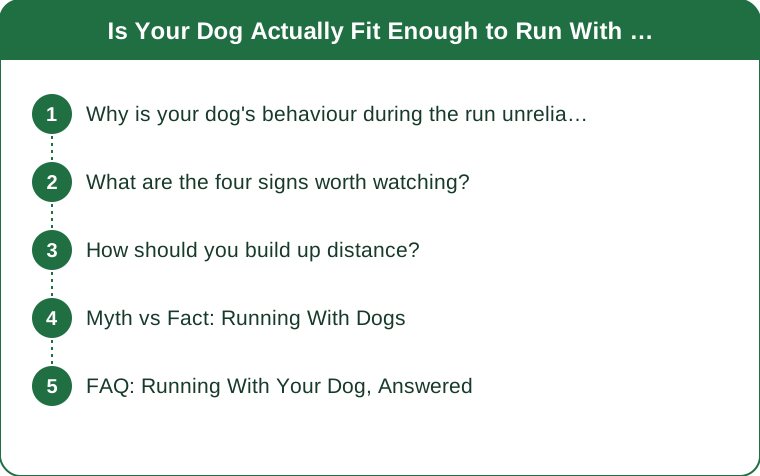
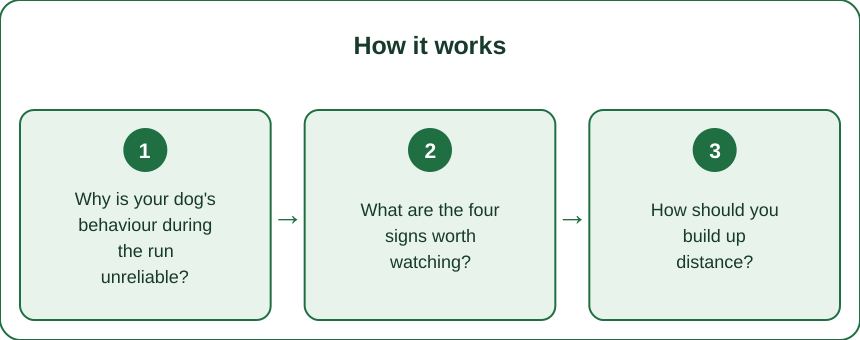
Why is your dog’s behaviour during the run unreliable?
Because the motivation to stay with you overrides a lot of what you would want them to tell you.
Dogs are strongly motivated to remain with their group. A dog running alongside you will typically continue past the point where they would have stopped on their own, because stopping means being left behind. This is not stubbornness or poor judgement - it is a social drive doing exactly what it evolved to do.
Their cooling system is also less capable than yours. Dogs cool primarily through panting and have very limited sweating, mostly through the paw pads. Humans sweat over the whole body, which is a far more effective mechanism. In warm weather, you have a substantial thermoregulatory advantage over your dog - and running in late summer heat is where this matters most.
Panting is normal and hard to read. A running dog pants constantly, so panting itself tells you very little. What matters is the character of it - very rapid shallow panting, a wide flat tongue, or excessive drooling suggest they are struggling to cope.
Some breeds are at markedly higher risk. Brachycephalic breeds - flat-faced dogs like pugs, bulldogs and boxers - have compromised airways and much poorer heat dissipation. Running them in warm weather carries real risk, and many should not be running distances at all.
Which means the useful information comes from three places: gait late in the run, recovery time after, and behaviour the following day.
What are the four signs worth watching?
In order of how reliable they are.
1. Recovery time - the best single indicator. A well-conditioned dog’s breathing should return to close to normal within roughly ten minutes of stopping, in reasonable conditions. Panting heavily 20-30 minutes later suggests the effort exceeded their conditioning.
Track it. It is the closest thing to an objective measure available without equipment.
2. Gait quality in the last third. Watch for a change from an efficient trot to a heavier, choppier stride, the head dropping, or falling behind your pace when they were beside you. A dog that starts lagging is telling you something they will not say by stopping.
3. Willingness the next day. A dog that is reluctant on the following walk, slower to get up, or stiff on rising has been worked beyond their current capacity. Enthusiasm the next morning is a good sign that the load was appropriate.
4. Behaviour that evening. A dog that cannot settle, repeatedly changes position, or seems restless may be uncomfortable. Deep, settled sleep after a run is normal and reassuring; restlessness is not.
Signs that mean stop immediately:
- Very rapid shallow panting with a wide, flattened tongue
- Bright red or unusually pale gums
- Stumbling, disorientation, or unsteadiness
- Vomiting or diarrhoea during or shortly after exercise
- Refusing to continue - an unusually clear signal, and one to respect immediately
Heat-related illness in dogs is a genuine emergency. Move to shade, offer cool water, wet the paws, belly and groin with cool water, and contact a vet.
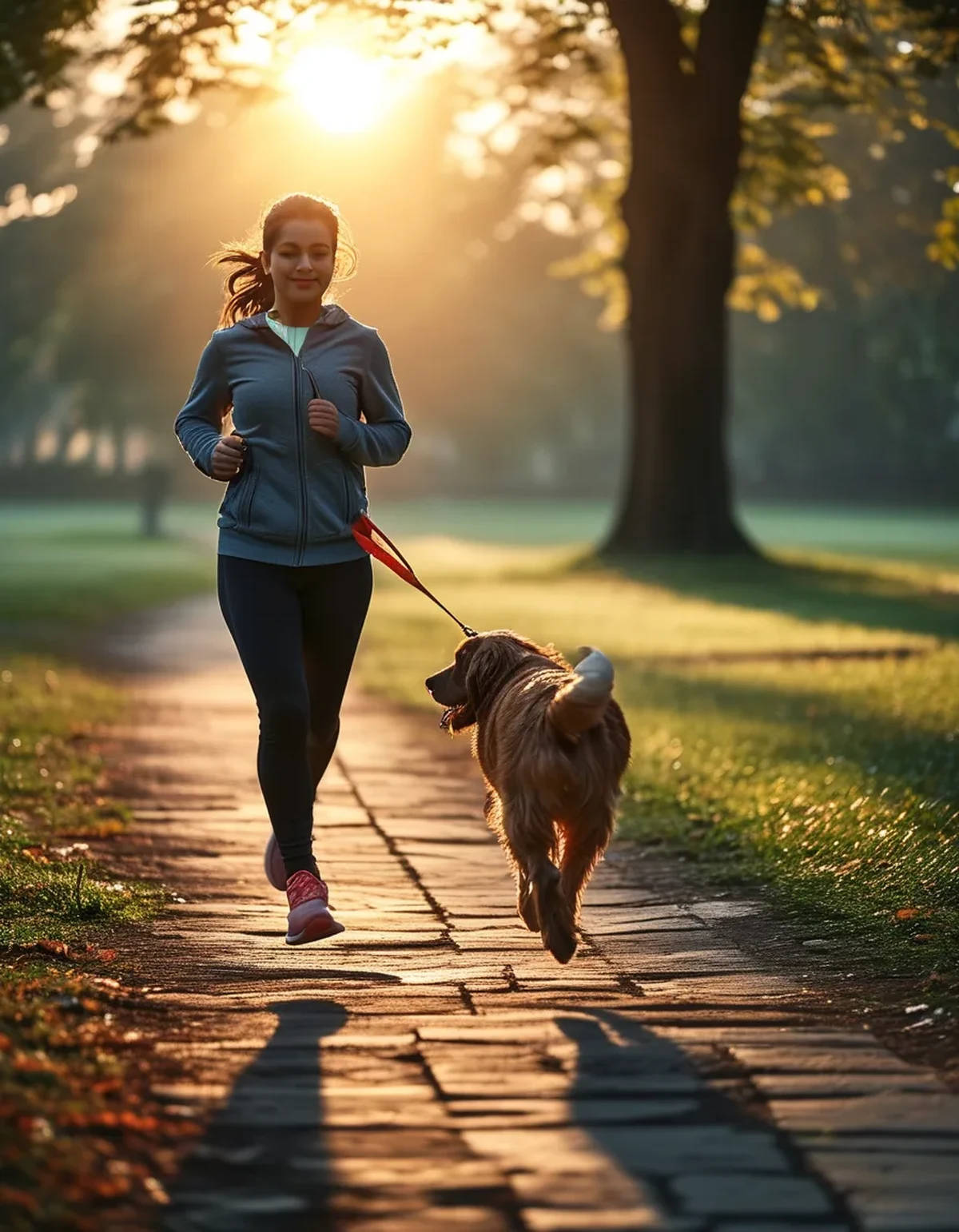
How should you build up distance?
Slowly, and starting later than most people do.
Growth plates come first, and this is the one that causes lasting harm. A dog’s growth plates - areas of developing cartilage near the ends of long bones - do not close until somewhere between roughly 12 and 18 months depending on size, with larger breeds taking longer.
Sustained repetitive running before closure carries risk of damage to developing joints. Free play and normal walks are fine and important; structured distance running is not. Your vet can advise on timing for your specific dog - it is worth asking rather than guessing.
For an adult dog starting out:
- Begin with what they already do comfortably on walks
- Introduce short jogging intervals within a normal walk - a few minutes at a time
- Increase total distance by roughly 10% per week, the same principle used for human runners
- Take rest days - consecutive hard days are as questionable for dogs as for people
Surface matters. Grass and trail are considerably kinder than pavement, and hot pavement in late summer can burn paw pads. The back of your hand held on the surface for five seconds is the standard test - too hot for you is too hot for them.
Older dogs need the opposite adjustment. Reduce distance and intensity while maintaining frequency, and watch for arthritis signs - stiffness on rising, reluctance on stairs, slowing on walks. Many older dogs are happier with two shorter outings than one long one.
Weather is a hard limit rather than a preference. In warm and humid conditions, run early or late, shorten the distance, choose shade, and be willing to cancel. A dog cannot tell you it is too hot in a way you will notice in time.
Myth vs Fact: Running With Dogs
Myth: If the dog keeps up, it is fine. Fact: Dogs continue past their limit because the drive to stay with you overrides fatigue. Keeping up is a measure of motivation, not of capacity.
Myth: Puppies need lots of exercise to burn energy. Fact: Puppies need play, socialisation and mental stimulation - not structured distance running. Growth plates are open until roughly 12-18 months, and repetitive impact before then carries real risk.
Myth: All dogs are natural runners. Fact: Breed differences are enormous. Brachycephalic dogs have compromised airways and poor heat dissipation. Very large breeds carry more joint load. Some breeds are built for distance and many are not.
Myth: Dogs will drink when they need to. Fact: A dog focused on running frequently will not stop to drink. Offering water at intervals rather than waiting for them to ask is the safer approach.
Myth: Panting means the dog is fine, it is just how they cool down. Fact: Panting is normal; the character of it matters. Very rapid shallow panting with a wide flat tongue indicates they are struggling to cope, not managing.
Myth: A tired dog is a happy dog. Fact: Appropriately exercised is the goal. Overexertion produces stiffness, reluctance and in warm conditions genuine danger - and mental stimulation tires many dogs more effectively than distance does.
FAQ: Running With Your Dog, Answered
How far can my dog run?
It depends on breed, age, conditioning and the weather, so there is no general number. Build gradually and use recovery time as your measure - breathing back near normal within about ten minutes suggests the distance was appropriate.
When can I start running with my puppy?
After growth plates close, typically somewhere between 12 and 18 months with larger breeds later. Ask your vet about your specific dog. Walks and free play in the meantime are appropriate and important.
How hot is too hot?
There is no single threshold, and humidity matters as much as temperature since panting depends on evaporation. Run early or late in warm weather, shorten the distance, and test the pavement with the back of your hand. When in doubt, walk instead.
Should I bring water?
On anything beyond a short run in cool conditions, yes - and offer it at intervals rather than waiting for the dog to ask. A running dog often will not stop to drink on its own.
What if my dog stops and refuses to continue?
Respect it immediately. Refusing is a strong signal from an animal strongly motivated to stay with you, and it means something has gone past their limit. Walk home and reassess the plan.
Is pavement bad for dogs to run on?
It is harder on joints than grass or trail, and in warm weather the surface temperature can burn paw pads. Mixing surfaces and choosing softer ground where possible is worth the small detour.
TL;DR:
- Dogs run past their limit because staying with you overrides fatigue - keeping up is motivation, not capacity
- Recovery time is the best indicator: breathing near normal within about ten minutes
- Watch gait quality late in the run, willingness the next day, and whether they settle that evening
- No structured running before growth plates close, typically 12-18 months and later for large breeds
- Build by roughly 10% per week, take rest days, and prefer grass or trail over pavement
- Heat is a hard limit - dogs cool by panting alone and brachycephalic breeds are at real risk
The run tells you very little. The ten minutes afterward and the next morning tell you everything.
Keep Reading
This article is for general informational and styling purposes only. Fit, sizing, and product availability may vary.