Are Dog Fitness Tracker Collars Actually Accurate, or Just a Fun Gadget?
Quick Answer: Dog fitness trackers are reasonably reliable at detecting relative activity level changes (more active today versus yesterday) and reasonably good at tracking rest versus active time, but their absolute step counts and calorie estimates are considerably less precise than human fitness trackers, since they’re calibrated against generalized breed and weight data rather than measuring an individual dog’s actual gait and metabolism directly.
Treating the numbers as a useful relative trend rather than an exact daily count is the more realistic way to use them.

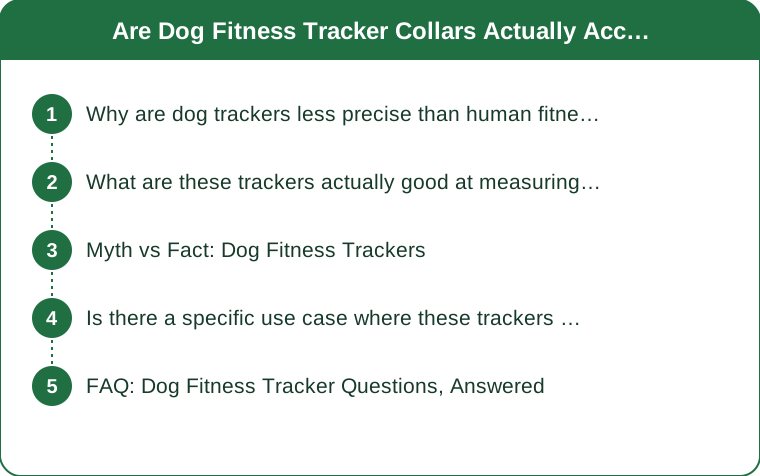
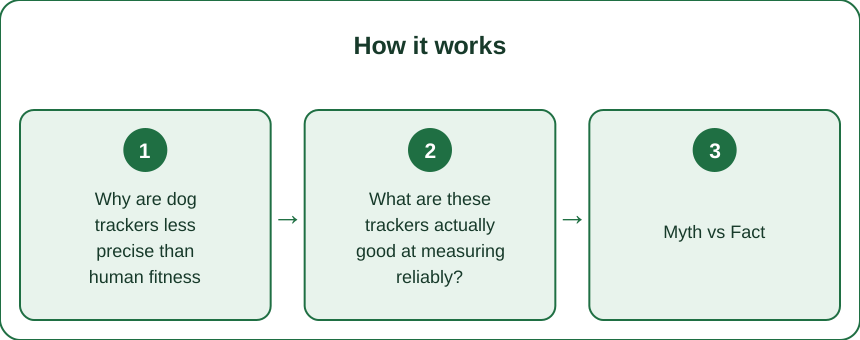
Why are dog trackers less precise than human fitness trackers for exact numbers?
Human fitness trackers are calibrated against a huge, individually-adjustable dataset of human gait patterns, while dog trackers have to generalize across enormously varied breed sizes, leg lengths, and gait styles, from a Chihuahua’s quick short strides to a Great Dane’s long, slow ones, using much broader assumptions to estimate steps and calorie burn.
This means the underlying algorithm has a harder job to begin with, and accuracy for an individual dog depends significantly on how closely that dog matches the breed and size profile the device’s algorithm was built around.
What are these trackers actually good at measuring reliably?
Relative activity trends — noticing when a dog is meaningfully more or less active than their own baseline, and distinguishing rest time from active time — tend to be fairly reliable, since this comparison is within the same dog’s own movement patterns rather than requiring precise cross-breed calibration.
This relative tracking is genuinely useful for noticing early signs of reduced activity that might indicate joint pain, illness, or aging, even if the exact daily step count isn’t precisely accurate.

Myth vs Fact: Dog Fitness Trackers
Myth: A dog tracker’s calorie burn estimate is as reliable as a human fitness tracker’s. Fact: Calorie estimates for dogs are considerably less precise due to breed and gait variability the algorithm has to generalize across.
Myth: If the step count seems off, the device is broken. Fact: Some inaccuracy in absolute step counts is expected and normal, even in a properly functioning device.
Myth: These trackers are purely a novelty with no real health value. Fact: Relative activity trend tracking has genuine value for catching early signs of reduced mobility or illness.
Is there a specific use case where these trackers provide the most practical value?
Monitoring recovery after surgery or injury, tracking activity changes in senior dogs, or noticing early signs of reduced mobility tend to be the most practically valuable use cases, since these all rely on relative trend detection (a real strength of these devices) rather than needing precise absolute numbers.
For a healthy, active dog with no specific health monitoring need, the tracker functions more as an engagement and awareness tool than a precise fitness metric, which is a reasonable use but worth having accurate expectations about.
FAQ: Dog Fitness Tracker Questions, Answered
Should I be concerned if my dog’s tracker shows very different numbers day to day for a similar routine?
Some day-to-day variability is normal and expected given the device’s generalized calibration; look at broader weekly trends rather than reacting to single-day fluctuations.
Do vets actually use data from these consumer trackers?
Some vets do find owner-reported tracker data useful as a supplementary data point, particularly for monitoring recovery or age-related activity decline, though it’s not treated as a precise clinical measurement.
Does tracker accuracy improve over time as it learns a specific dog’s patterns?
Some models do use a degree of adaptive calibration over time, though the improvement is generally modest rather than eliminating the underlying breed-and-gait generalization issue.
TL;DR:
- Dog trackers are more reliable for relative activity trends than for precise absolute step counts
- Breed and gait variability make cross-dog calibration much harder than human fitness tracking
- The most practical value is in monitoring recovery, aging, or early mobility changes over time
- Treating the numbers as a trend indicator rather than an exact count sets more realistic expectations
The gadget is genuinely useful — just not for the reason most people initially expect.
Keep Reading
This article is for general informational and styling purposes only. Fit, sizing, and product availability may vary.