Swimming With Your Dog: What It Actually Does for Their Fitness, and Who Should Not
Quick Answer: Swimming is genuinely excellent conditioning for most dogs — roughly one minute of swimming is comparable to four minutes of running for cardiovascular load, with almost no joint impact. But it is much harder than it looks, dogs hide fatigue in water, and several breeds are physically poor swimmers. Start with three to five minutes and build gradually, and never assume a dog can swim because it is a dog.
There is a persistent belief that all dogs can swim instinctively. Many can. Several breeds genuinely cannot, and a number of the dogs who can are far worse at it than their enthusiasm suggests.
Used properly, water work is one of the best conditioning tools available — particularly for older dogs and for anything with joint issues. Used carelessly, it is one of the faster ways to exhaust a dog badly.

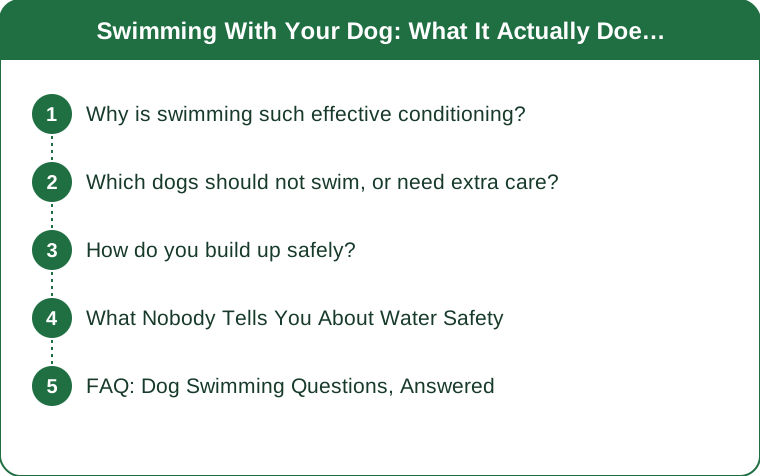
Why is swimming such effective conditioning?
Water is roughly 800 times denser than air, which changes the exercise entirely.
Every limb movement works against substantial resistance, which means the cardiovascular demand at a given speed is far higher than on land. The commonly cited ratio is that one minute of swimming approximates four to five minutes of running in terms of cardiovascular work, and while that figure is approximate, the direction is clearly right.
At the same time, buoyancy removes almost all impact loading. Joints move through full range under resistance without compression, which is why hydrotherapy is standard in veterinary rehabilitation after orthopaedic surgery and for dogs with hip dysplasia or arthritis.
The muscular pattern is also different. Swimming recruits the core, shoulders and hip flexors heavily — muscle groups that walking barely touches. Dogs who swim regularly often develop noticeably better topline and rear-end strength than dogs who only walk.
The practical implication is the one owners get wrong: because it looks like play, it does not get counted as exercise. A dog who swims for twenty minutes has done a hard workout, and treating that as a warm-up before a long walk is how dogs end up genuinely overexerted.
Which dogs should not swim, or need extra care?
Several categories, and some of them surprise people.
Brachycephalic breeds — bulldogs, French bulldogs, pugs, Boston terriers. These dogs have a body shape that works against swimming: heavy front ends, short muzzles that sit close to the waterline, and compromised breathing under exertion. English and French bulldogs in particular frequently cannot swim at all and sink. They should never be near water without a properly fitted life jacket and direct supervision.
Dogs with short legs and long bodies — dachshunds, corgis, basset hounds. They can often swim but tire fast and struggle to get out of the water. The exit is frequently the danger, not the swimming.
Very heavy or muscular breeds — some mastiffs and bull breeds have low body fat and dense muscle, which makes them poorly buoyant. They swim with a lot of effort and tire quickly.
Senior dogs and dogs with heart conditions need veterinary clearance. Swimming is often excellent for arthritic seniors and is a real cardiovascular load that a compromised heart may not tolerate.
Dogs with ear issues are more prone to infection after swimming, particularly floppy-eared breeds. Dry the ears afterwards.
Natural swimmers — retrievers, spaniels, poodles, Newfoundlands, most water breeds — are built for it, and their main risk is the opposite: they will keep going long past the point of fatigue because they are enjoying themselves.

How do you build up safely?
The progression matters because dogs do not self-regulate in water.
Session 1 to 3: three to five minutes. That is all. It will feel absurdly short and your dog will want to continue. Watch what happens over the following 24 hours — a dog who is stiff or unusually flat the next day was overdone.
Weeks 2 to 3: build to eight to ten minutes, with breaks. Structured swimming in intervals — two minutes in, one minute resting on land — is easier on a dog than continuous work and lets you see fatigue.
Week 4 onward: fifteen to twenty minutes is a solid conditioning session for a fit adult dog. Beyond that you are into territory where fatigue risk climbs and the additional benefit is limited.
Signs of fatigue to watch for, and they appear before a dog will stop voluntarily: the rear end dropping lower in the water, an increasingly vertical body angle, front paws splashing higher, and any change in breathing pattern. The rear-end drop is the earliest reliable sign and the most important one to learn.
Always plan the exit before you start. A tired dog in a lake with steep banks is a genuine emergency. Know where the shallow exit is, and for pools, teach the location of the steps deliberately — a dog in a panic will not find them.
Life jackets are not just for weak swimmers. For open water, boats, or any dog new to swimming, a fitted flotation vest with a handle is straightforwardly sensible.
What Nobody Tells You About Water Safety
Several things that are worth knowing before the next warm weekend.
Blue-green algae is the real seasonal danger, and late summer is peak season for it. Cyanobacteria blooms in warm, still, nutrient-rich fresh water can be fatal to dogs within hours of ingestion, and dogs ingest a lot of water while swimming. The visual signs are a green, blue-green or brown scum on the surface, sometimes described as looking like spilled paint. If the water looks off, do not let the dog in. This risk peaks from mid-summer through early autumn and does not fully disappear until water temperatures drop.
Water intoxication is real but rare. Dogs who repeatedly bite at water or retrieve from the surface can swallow enough to dilute their blood sodium dangerously. The risk is highest in dogs who play hard with hoses and sprinklers or who retrieve for extended periods. Break up long retrieving sessions.
Saltwater causes vomiting and diarrhoea if a dog drinks much of it. Bring fresh water and offer it frequently at the beach.
Cold water matters more than owners think. As we move into September, lake and river temperatures drop faster than air temperatures, and a dog who swam comfortably in August may be swimming in noticeably colder water by late September. Small dogs, thin dogs and seniors lose heat fast.
Rinse afterwards. Chlorine, salt and lake bacteria all irritate skin, and a rinse plus a dry of the ears prevents most post-swim problems.
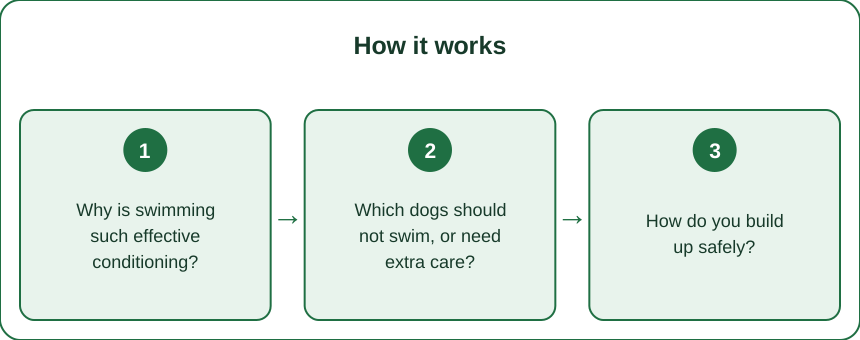
FAQ: Dog Swimming Questions, Answered
How often can my dog swim?
Two to three sessions a week is plenty for conditioning, with rest days in between as you would for any strength work. Daily swimming for a dog who is not conditioned for it leads to overuse, particularly in the shoulders.
Can swimming replace walks?
Not entirely. Swimming is superior conditioning but walks provide sniffing and mental stimulation, which is a genuine welfare need rather than an optional extra. A swim is not a substitute for a walk in terms of enrichment.
Is a pool better than a lake?
Pools are safer and more controlled; lakes provide more interest and avoid chlorine. If using a pool, rinse afterwards. If using open water, check for algae and know the exit.
My dog is scared of water. Should I push?
No. Forced introduction to water reliably creates lasting fear. Build slowly with shallow wading, treats and a confident companion dog if one is available. Some dogs never enjoy swimming, and that is fine — there are other ways to condition them.
How do I know if my dog is a poor swimmer before finding out the hard way?
Start in shallow water where they can stand, with a life jacket, and watch the body angle. A capable swimmer holds a fairly horizontal position with quiet paddling. A struggling swimmer sits vertical in the water with the front paws splashing above the surface.
This is general information, not veterinary advice. Check with your vet before starting swimming with a senior dog, a dog with a heart condition, or a dog recovering from injury.
TL;DR:
- Swimming is roughly four times the cardiovascular work of running per minute, with near-zero joint impact.
- Brachycephalic breeds, long-backed breeds and heavy muscular breeds are poor swimmers — some cannot swim at all.
- Start at three to five minutes and build over a month; watch for the rear end dropping as the first fatigue sign.
- Check for blue-green algae in late summer and know the exit before your dog gets in.
Water work is one of the best conditioning tools you have for a dog, particularly an older one or one with joint problems. It just needs to be treated as the hard exercise it is rather than as the game it looks like.
Keep Reading
This article is for general informational and styling purposes only. Fit, sizing, and product availability may vary.