What to Do When Your Dog Clearly Hates the Exercise Routine You Picked
Quick Answer: Signs a dog dislikes an exercise routine include lagging behind, reluctance to start, and lower energy during the activity compared to elsewhere — these usually mean the specific activity type or intensity is a mismatch for that dog’s individual temperament, not that the dog needs to be pushed through it, and switching to a better-matched activity typically resolves it.
A lot of exercise advice assumes all dogs enjoy the same handful of popular activities. Plenty of dogs clearly don’t, and pushing through it isn’t the right response.

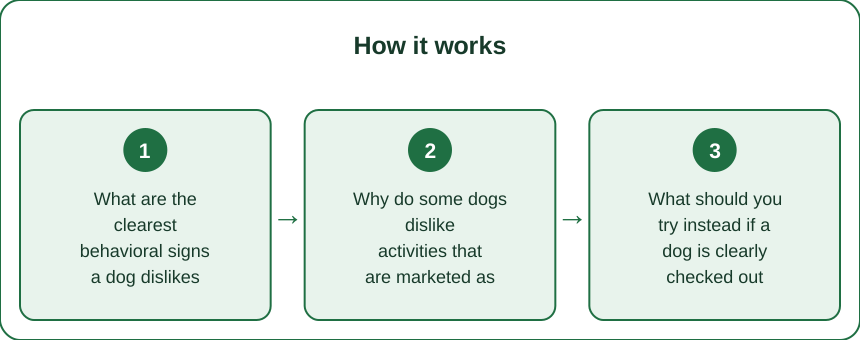
What are the clearest behavioral signs a dog dislikes their exercise routine?
Lagging behind on walks, reluctance or avoidance behavior when the activity starts, and noticeably lower energy or engagement during the activity compared to how that same dog behaves in other contexts are the clearest signals. These are different from normal fatigue — they reflect the dog’s actual preference, not just tiredness.
Why do some dogs dislike activities that are marketed as universally dog-friendly, like fetch or running?
Individual dogs vary enormously in breed-driven instincts, energy type, and even personality, similar to how not every person enjoys running even though it’s a popular, broadly promoted form of exercise. A dog bred more for scent work or low-intensity companionship may genuinely find high-intensity fetch or running less rewarding than a slower, exploration-focused walk, regardless of how popular that activity is generally.
What should you try instead if a dog is clearly checked out during a popular activity?
Lower-intensity, exploration-driven activities like scent walks (letting the dog set the pace and sniff extensively) tend to work well for dogs that disengage from high-intensity fetch or running, since they tap into a different, often more naturally rewarding, drive than repetitive high-energy activity.

Myth vs Fact: Matching Exercise to Your Dog
Myth: All dogs need the same amount of high-intensity exercise to be healthy. Fact: Exercise needs and preferences vary significantly by breed and individual temperament — matching type and intensity to your specific dog matters more than following generic advice.
Myth: A dog that seems reluctant just needs more consistency to learn to enjoy it. Fact: Persistent reluctance is more often a genuine mismatch signal than something that resolves with repetition alone.
Does age or health status ever explain apparent activity dislike rather than personality?
Yes — joint discomfort, vision changes, or general aging can make a previously enjoyed high-intensity activity noticeably less appealing, and this can be mistaken for a personality preference rather than a physical change. If a previously enthusiastic dog suddenly shows reluctance, a vet check is a reasonable first step before assuming it’s purely preference.
FAQ: Dogs That Dislike Their Exercise Routine, Answered
How long should you try a new activity before deciding a dog doesn’t enjoy it?
A few sessions, watching for consistent reluctance rather than one off day, gives a more reliable read than a single session.
Can a dog’s exercise preference change over time?
Yes, preferences can shift with age, health, and even life experience, so periodically reassessing rather than assuming a fixed preference is worthwhile.
Is it okay for a dog to have a lower-intensity exercise routine than typical breed expectations suggest?
Yes, matching actual observed preference and health status matters more than a generic breed-based exercise expectation.
TL;DR:
- Lagging, reluctance, and low engagement are clear signs of an activity mismatch
- Not every dog enjoys popular activities like fetch or running, and that’s normal
- Lower-intensity, exploration-based activities like scent walks work well for many mismatched dogs
- Sudden new reluctance in a previously enthusiastic dog is worth a vet check
If your dog seems to dread the current routine, try swapping in a slower, sniff-focused walk for a week and watch how differently they engage.
Keep Reading
This article is for general informational and styling purposes only. Fit, sizing, and product availability may vary.