Your Dog Suddenly Wants More Exercise: What the First Cool Weather Does
Quick Answer: Dogs offload heat far less efficiently than people, so summer heat genuinely limits how much they can do. When temperatures drop, that limit lifts and activity capacity rises quickly - but the tissue conditioning built over a low-activity summer has not risen with it. Increase duration by roughly 10 percent per week rather than doubling in a weekend.
The injuries that show up in September clinics are almost all the same story: a dog that had a quiet summer doing a two-hour hike on the first cool Saturday.
This is general information rather than veterinary advice.
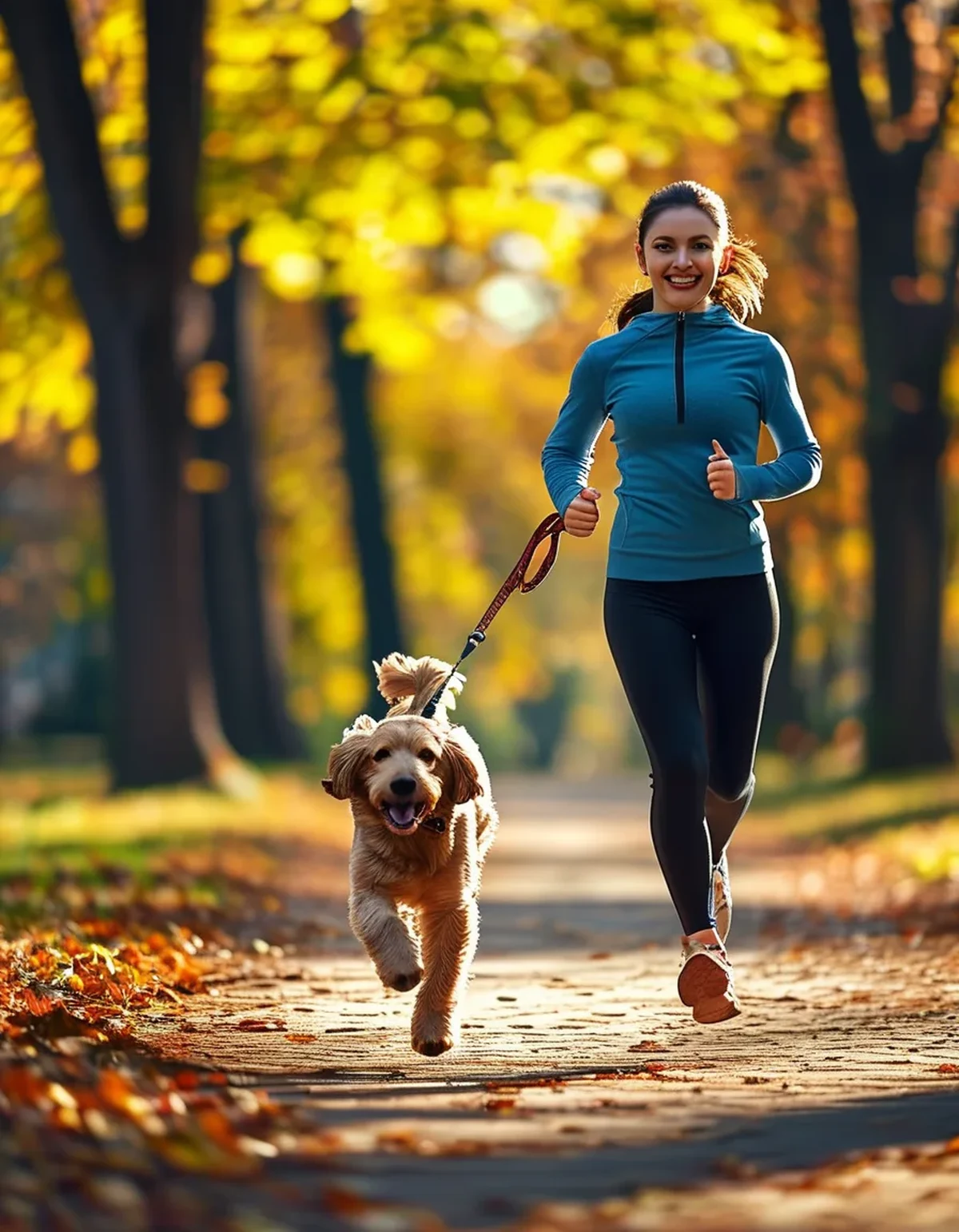
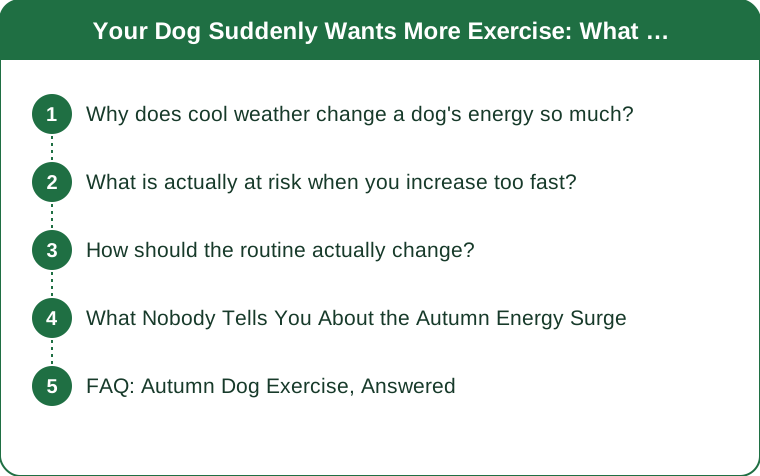
Why does cool weather change a dog’s energy so much?
Because heat, not fitness, was the binding constraint for most of the summer.
How dogs shed heat. Primarily through panting, with a small contribution from the paw pads. They do not sweat across the body the way humans do. Panting is far less efficient than sweating, and its efficiency falls as humidity rises.
What that means in practice. In hot weather a dog reaches its thermal limit long before its cardiovascular limit. The dog was not unfit or unwilling in August - it was overheating, and slowing down was the correct behavior.
Which breeds are most affected:
- Brachycephalic breeds - pugs, bulldogs, boxers - whose shortened airways make panting dramatically less effective. They are heat-limited at temperatures other dogs tolerate easily
- Double-coated northern breeds - huskies, malamutes, some shepherds - which are insulated for cold and struggle badly in heat
- Large and giant breeds, which have less surface area relative to body mass
- Older, overweight, and very young dogs across all breeds
What lifts when the temperature drops:
- The thermal ceiling rises, so the dog can sustain effort for far longer
- Recovery between bouts speeds up, so a dog that needed to lie down after ten minutes now wants to keep going
- Many dogs become noticeably more playful and more reactive to stimuli in cool air
Which produces the September problem. The dog’s willingness has jumped, and the owner reads it as the dog needing more. The dog does want more. The dog’s tendons, ligaments and paw pads are not ready for more, because they have spent three months doing less.
What is actually at risk when you increase too fast?
Soft tissue and paw pads, in roughly that order.
Soft tissue conditioning takes longer than fitness. Cardiovascular fitness improves within weeks, but tendons and ligaments adapt considerably more slowly. A dog can feel ready long before its connective tissue is ready, and dogs give almost no warning signals before an acute injury.
The common autumn injuries:
- Cranial cruciate ligament injuries, which frequently occur during sudden high-intensity activity in an unconditioned dog. This is one of the most common orthopedic injuries in dogs and often happens during play or a sudden turn
- Soft tissue strains in the shoulders and hips, particularly in dogs doing sudden long hikes
- Iliopsoas strain, common in active dogs increasing volume quickly
Paw pads deserve their own mention. Pads condition to surfaces the way human feet do. A summer of short walks on grass leaves pads soft, and a long autumn hike on gravel or trail will abrade them raw. This is extremely common and entirely preventable.
- Check pads after every longer-than-usual outing
- Increase distance on rough surfaces gradually - pads take several weeks to toughen
- Watch for limping that appears at the end of a walk rather than the start
Warning signs that a dog is doing too much:
- Stiffness the following morning, which is the clearest and most-missed signal
- Reluctance to jump into the car or onto furniture
- A lick spot appearing on a particular joint
- Slowing at the end of walks where they used to finish strong
- Any limping at all, which in dogs generally indicates meaningful discomfort rather than mild soreness
On the 10 percent guideline. Increasing weekly duration by roughly 10 percent is the standard conservative progression borrowed from human running, and it works well for dogs. Two weeks of moderate build gets a dog to a place where a long weekend hike is reasonable. One weekend does not.
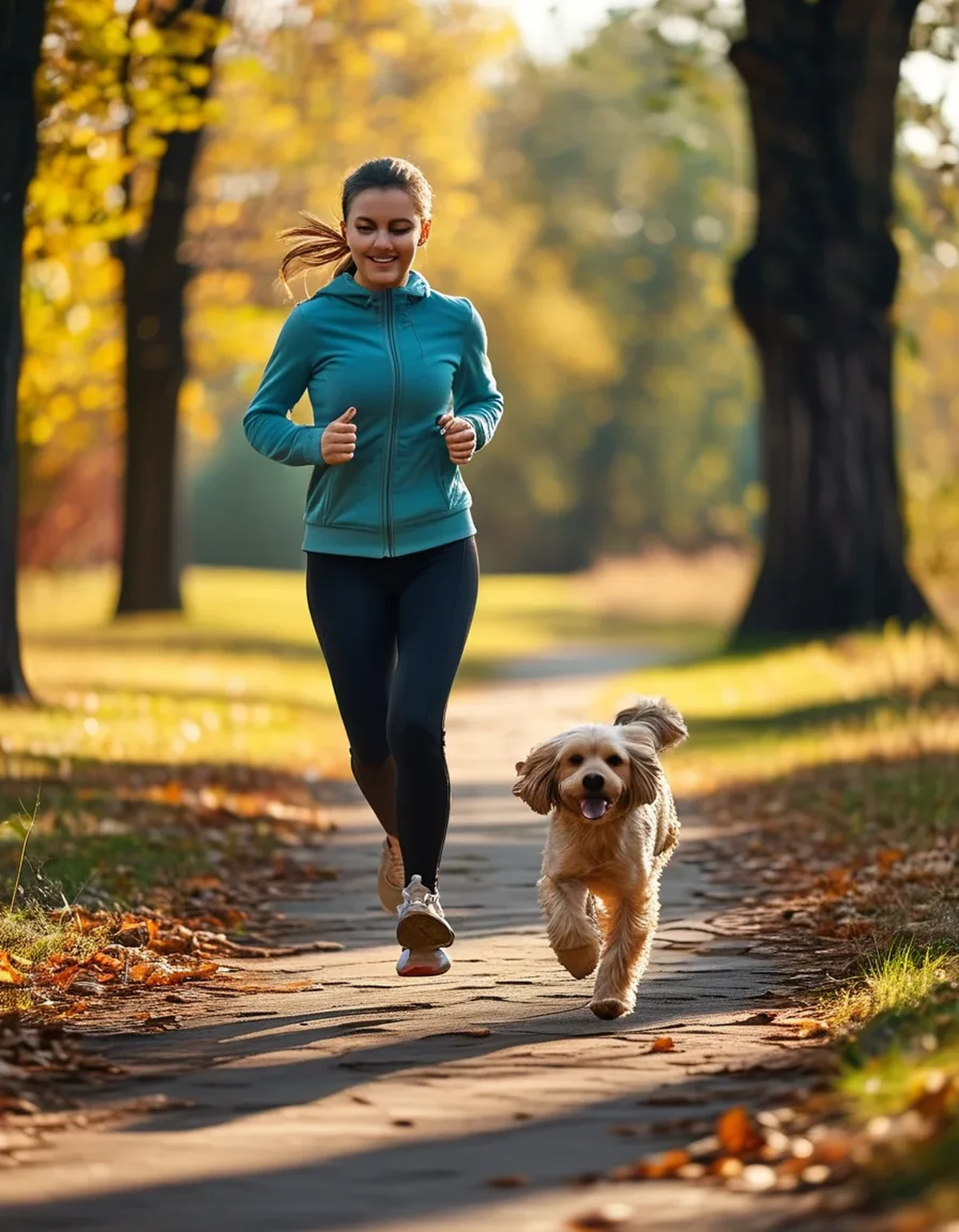
How should the routine actually change?
Build gradually, and use the cool weather for the things heat prevented.
A sensible four-week progression from a low-activity summer:
- Week 1: current duration plus about 10 percent, with one slightly faster walk
- Week 2: another 10 percent, adding a short off-lead or fetch session on grass
- Week 3: another 10 percent, introducing one longer outing at easy pace
- Week 4: the first genuinely long hike, on a surface the dog has been on recently
What cool weather makes newly possible:
- Midday activity, which was off-limits in summer heat. This is a large practical gain for anyone whose schedule is awkward
- Longer sustained efforts, including running with the dog, which is often unsafe in summer
- Hard-surface walking, since pavement temperature is no longer the limiting factor
- Play sessions that go past ten minutes without the dog needing to stop
What still needs care in autumn:
- Warm-up matters more in cool weather. Five minutes of walking before any running or fetch reduces strain risk noticeably, and cold muscle is stiffer muscle
- Wet leaves are slippery for dogs too, particularly on slopes and when turning at speed
- Shorter daylight means visibility gear for both of you - a light-up collar or a reflective harness
- Water still matters. Dogs drink less when it is cool and can still become dehydrated on long efforts
On the multi-dog household, where this gets complicated: the fittest dog sets the pace and the least fit dog pays for it. Autumn energy surges vary hugely by breed and age, and a young dog’s return to full capacity does not mean the senior dog is ready for the same. Separate outings, or a shorter loop for one, is usually the honest answer.
What Nobody Tells You About the Autumn Energy Surge
Behavior problems often improve in autumn, and the reason is exercise volume. A dog that could not be adequately exercised in summer heat was very likely under-stimulated, and the resulting behavior was read as a training problem. Cool weather quietly fixes some of it.
Stiffness the next morning is the signal owners miss most. Dogs do not complain and often move normally once warmed up. Check how they get up first thing, which is where soreness shows.
Paw pads are the most common autumn casualty and the least discussed. Soft summer pads meeting autumn trail surfaces produce abrasion that owners discover as bleeding at home.
Older dogs feel autumn too. Senior dogs often become visibly more comfortable and more active as heat lifts, and it is easy to overestimate what has changed. Arthritis is generally worse in cold and damp, so late autumn may reverse the gain - the September surge in an old dog is temporary.
Ticks do not stop in autumn. In many regions autumn is a second peak, and the drop in temperature leads people to relax preventatives at exactly the wrong moment.
The dog’s appetite may rise too. More activity plus cooler weather generally increases intake, which is normal - but the reverse matters in winter, when activity falls and food often does not.
FAQ: Autumn Dog Exercise, Answered
Why does my dog have so much more energy now?
Heat, not fitness, limited them through summer. Dogs shed heat mainly by panting, which is far less efficient than sweating, so cooler air lifts a real ceiling on what they can do.
How fast can I increase walk length?
About 10 percent per week. Cardiovascular fitness improves quickly but tendons, ligaments and paw pads adapt much more slowly.
What is the most common autumn injury?
Soft tissue strains and cruciate ligament injuries from sudden high-intensity activity in an unconditioned dog, plus abraded paw pads on rough surfaces.
How do I know if my dog is doing too much?
Stiffness the next morning is the clearest sign, along with reluctance to jump, licking at a joint, or slowing at the end of walks. Any limping warrants rest and a vet check.
Do paw pads really need conditioning?
Yes. Pads soften over a low-activity summer and take several weeks of gradually increasing rough-surface walking to toughen. Check them after every longer outing.
Does this apply to senior dogs too?
They often feel better as heat lifts, but the improvement can be temporary once cold and damp arrive, since arthritis typically worsens then. Build even more gradually.
TL;DR:
- Heat, not fitness, limited your dog all summer - dogs cool by panting, which is far less efficient than sweating
- Willingness jumps immediately; tendons, ligaments and paw pads have not changed at all
- Increase duration about 10 percent per week; a four-week build gets you to a long hike safely
- Morning stiffness is the signal owners miss most, and any limping means stop
- Warm up before running or fetch, watch wet leaves, and add visibility gear as daylight shortens
The first cool Saturday is when most autumn dog injuries happen. Make it a moderate walk, not the big hike.
Keep Reading
This article is for general informational and styling purposes only. Fit, sizing, and product availability may vary.