The Pavement Test Every Dog Owner Should Do Before an August Walk
Quick Answer: Asphalt can reach 125 to 145°F on an 85 to 90°F day in direct sun — hot enough to burn paw pads in under a minute. Test it by pressing the back of your hand flat on the surface for seven seconds. If you cannot hold it comfortably, your dog cannot walk on it. Grass, shade, and early morning are the answers; booties are a distant fourth.
The air said 87 degrees. The sidewalk was doing something entirely different.
This is the gap that catches out even careful owners, because nothing about the walk feels dangerous until the damage is already done.

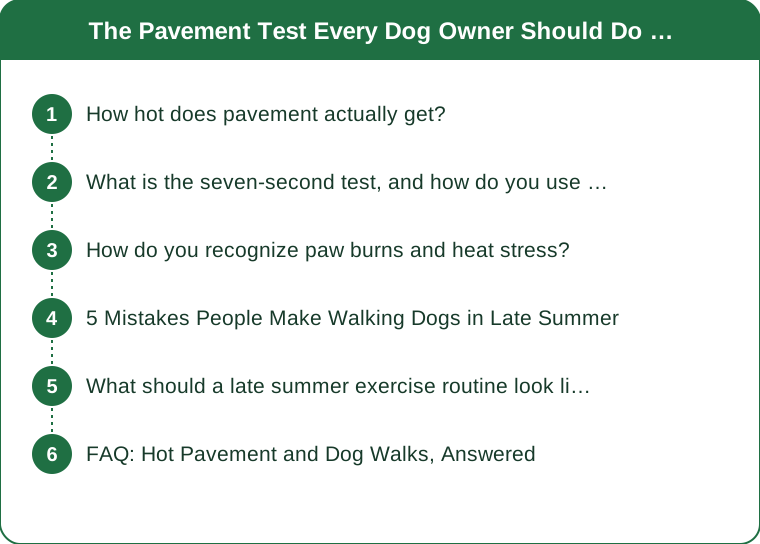
How hot does pavement actually get?
Far hotter than air temperature suggests, and the gap widens as the day goes on.
Approximate asphalt surface temperatures in direct sun:
- 77°F air → around 125°F asphalt
- 86°F air → around 135°F asphalt
- 87°F air → around 143°F asphalt
For context, skin and paw pad tissue can be damaged by sustained contact at around 125°F, and an egg reportedly fries on a surface at about 131°F. Those numbers are reached on days most people would describe as merely warm.
Why the gap is so large: dark asphalt absorbs a large share of the solar radiation that hits it and converts it to heat. Air moves and mixes; pavement sits there accumulating. Concrete runs cooler than asphalt but is still far hotter than air. Artificial turf gets hotter than either, which surprises people who assume anything green is safe. Metal — manhole covers, drain grates, truck beds — is worst of all.
Timing matters enormously. Surfaces continue absorbing heat through the afternoon and release it slowly into the evening. Pavement at 7pm can still be dangerously hot on a day that peaked at 95°F, which is exactly when many people schedule the evening walk because the air has cooled.
That lag is the single most useful thing to know here: cooler air does not mean a cooler surface.
What is the seven-second test, and how do you use it?
Place the back of your hand flat against the surface and hold it for seven seconds.
If you cannot keep it there comfortably for the full seven, the surface is too hot for your dog’s paws. That is the entire test, and it takes less time than clipping the leash.
Use the back of your hand, not the palm. Palms are calloused and less sensitive, and they will tell you a surface is fine when it is not.
Test the actual route, not just the doorstep. A shaded front step tells you nothing about the sunlit stretch two blocks along. If your route crosses an open parking lot or a wide road, test there — or plan around it.
Test again on the way back. Surface temperature climbs through the day, and a walk that started fine can become a problem on the return leg. This catches out people on longer walks.
What to do when it fails:
- Walk on grass or dirt, which run dramatically cooler than any paved surface
- Move the walk to early morning — the two hours after sunrise, when surfaces have shed overnight heat
- Find shaded routes, which make a large difference on the surface, not just for you
- Shorten it and do indoor enrichment instead — a food puzzle, training, or indoor games tire many dogs more than a short walk does
Booties are a real option but a limited one. Many dogs tolerate them poorly, they can slip, and they interfere with the paw’s own thermoregulation. They are useful for dogs that accept them and for unavoidable surfaces — not a license to walk on 140°F asphalt.
How do you recognize paw burns and heat stress?
Paw pad burns are frequently missed because dogs keep walking on them.
Signs of paw pad damage:
- Limping or refusing to walk, or suddenly sitting down mid-walk
- Licking or chewing at the paws afterward, sometimes hours later
- Pads that look darker than usual, red, or noticeably paler
- Visible blisters or missing patches of pad surface
- Reluctance to go out on subsequent days, which is often the first thing an owner notices
If you suspect a burn: get the dog off the hot surface immediately — carry them if you can — cool the paws with cool (not ice cold) water, and contact your vet. Pad burns can be serious, are prone to infection, and are painful in a way dogs often hide.
Heat stress in dogs is a separate and more urgent risk. Dogs cool primarily by panting, which becomes far less effective in humidity, and they cannot sweat meaningfully. Watch for:
- Heavy, frantic panting that does not slow when you stop
- Thick, ropy drool
- Bright red or unusually pale gums
- Weakness, stumbling, or disorientation
- Vomiting or diarrhea
- Collapse — an emergency
Higher-risk dogs: flat-faced breeds like bulldogs, pugs, and boxers, whose airway anatomy makes panting far less effective; overweight dogs; puppies and senior dogs; dogs with heart or respiratory conditions; and thick-coated northern breeds.
If you suspect heat stroke, this is an emergency. Move to shade or air conditioning, apply cool water to the body — especially the belly, armpits, and paws — offer small amounts of water, and get to a vet immediately. Do not use ice water, which can constrict blood vessels and slow cooling. This is general information, not veterinary advice — your vet’s guidance for your specific dog takes precedence.

5 Mistakes People Make Walking Dogs in Late Summer
Mistake 1: Using air temperature as the decision. The air is not what the paws touch. An 82°F day with full sun and no shade on the route is more dangerous for paws than an 88°F day on a shaded dirt trail. Test the surface, every time, for the whole season.
Mistake 2: The evening walk on stored heat. This is the most common trap. The air has cooled, the sun is down, and the asphalt has been absorbing heat for eight hours and is still releasing it. Evening pavement in late summer frequently fails the seven-second test long after it feels comfortable to you.
Mistake 3: Assuming the dog will stop if it hurts. Many dogs will keep walking through pain, especially when excited or focused on the walk. Some breeds are notably stoic about it. Your dog not complaining is not evidence that the surface is fine.
Mistake 4: Same route, same distance, all year. A dog’s exercise needs do not change with the season, but the safe way to meet them does. Late summer usually means shorter walks plus more indoor mental work, not the same walk in worse conditions.
Mistake 5: Leaving the dog in the car “just for a minute.” Car interiors heat extremely fast — a large rise within minutes even with windows cracked, and cracked windows make very little difference. There is no safe version of this on a hot day, and it kills dogs every summer.
What should a late summer exercise routine look like?
The goal is to meet the dog’s needs, not to complete the usual walk.
Shift the schedule. Early morning is the best window by a wide margin: coolest air, coolest surfaces, and low sun. Late evening works only if the surface passes the test — check, do not assume.
Change the surface, not just the time. Grass, dirt trails, shaded woodland, and sand are all dramatically cooler than paving. A drive to a shaded trail beats a walk from the door on a hot day.
Substitute mental work for physical distance. This is the piece most owners underuse. Scent work, food puzzles, training sessions, and snuffle mats tire many dogs more effectively than a walk of the same duration. Fifteen minutes of nose work can settle a dog that a thirty-minute walk would not.
Use water where you safely can. Shallow paddling, a hose, or a clean dog-friendly swimming spot provides exercise and cooling at once. Supervise closely, rinse afterward, and be careful with dogs that gulp water while swimming.
Adjust intensity, not just duration. Fetch and running games generate a lot of internal heat quickly, and dogs will chase a ball past the point of safety. In heat, prefer sniffing walks over high-intensity play.
Bring water on any walk over about fifteen minutes, and offer it more often than you think necessary. A collapsible bowl weighs nothing.
Reassess at the end of the season. Fitness declines over a hot stretch of reduced activity, so rebuild distance gradually when the weather turns rather than jumping straight back to July’s routine.
FAQ: Hot Pavement and Dog Walks, Answered
At what air temperature should I stop walking on pavement?
There is no clean number, because sun exposure, surface type, and time of day matter more than air temperature. Use the seven-second hand test instead — it accounts for all of those at once.
Do dog booties actually work?
For dogs that tolerate them, yes, they provide real protection. Many dogs do not tolerate them, they can affect gait and grip, and they reduce the paw’s own heat exchange. Treat them as a tool for specific situations, not a substitute for choosing a cooler surface.
Is grass really that much cooler than pavement?
Yes, substantially. Grass reflects more solar energy, retains far less heat, and is cooled by moisture from the plant itself. It is the single easiest surface swap available.
What about concrete versus asphalt?
Concrete runs cooler than dark asphalt because it is lighter and reflects more, but it still gets far hotter than air temperature and still needs the seven-second test. Artificial turf is the worst of the common surfaces and is often mistaken for a safe one.
My dog seems fine — do I still need to worry?
Yes. Dogs frequently walk through pad pain without signalling it, and paw burns often become obvious hours later. The test costs seven seconds; the alternative costs a vet visit.
TL;DR: Air temperature does not tell you what your dog is walking on.
- Asphalt hits 125 to 145°F on 77 to 87°F days — hot enough to damage paw pads in under a minute.
- Use the seven-second test: back of your hand flat on the surface. Cannot hold it, cannot walk on it.
- Evening pavement is the trap — surfaces stay hot for hours after the air cools.
- Grass, dirt, and shade run dramatically cooler. A drive to a shaded trail beats a walk from the door.
- Swap distance for mental work — scent games and puzzles tire dogs more than a short hot walk.
- Know both risks: pad burns show up as limping and paw licking; heat stroke shows as frantic panting, ropy drool, and stumbling, and is an emergency.
Do the hand test before your next walk. It takes seven seconds and it is the whole decision.
Keep Reading
This article is for general informational and styling purposes only. Fit, sizing, and product availability may vary.