Why Some Dogs Need Convincing to Exercise and Others Never Stop Asking
Quick Answer: A dog’s exercise motivation is shaped by a combination of breed drive, individual temperament, and past experience with exercise (positive or negative), not just raw energy level or fitness — a dog with genuinely low exercise motivation often responds better to shorter, more engaging, reward-based sessions than to simply being pushed through a longer walk, while a highly motivated dog usually needs more structured outlets to avoid the opposite problem of overexertion or frustration.
Exercise motivation in dogs works a lot like it does in people — matching the activity to temperament matters more than defaulting to the same routine for every dog.

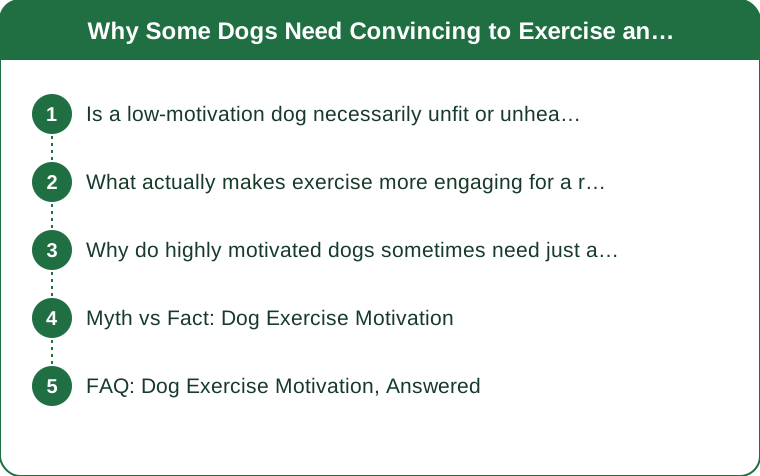
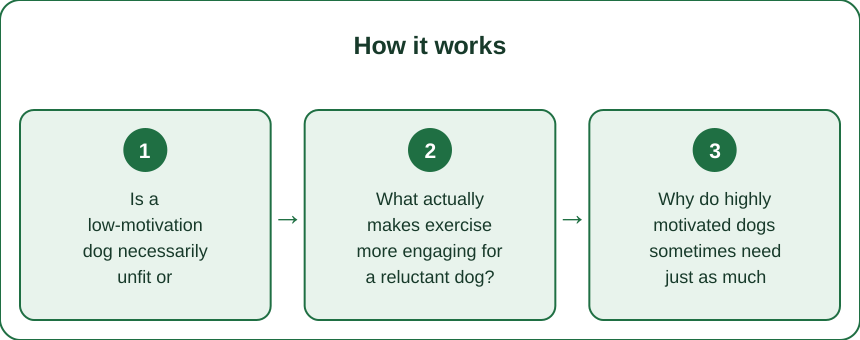
Is a low-motivation dog necessarily unfit or unhealthy?
Not necessarily — some dogs, particularly certain breeds bred for lower-energy companionship roles, have genuinely lower natural drive for sustained physical activity, which is a temperament trait rather than automatically a fitness or health problem, though any sudden drop in a previously active dog’s motivation is worth checking with a vet.
What actually makes exercise more engaging for a reluctant dog?
Shorter sessions with more variety, novel routes, and reward-based engagement (treats, play, sniffing time) tend to build motivation better than a longer walk on the same route, since predictability itself can reduce a low-drive dog’s interest over repeated sessions.

Why do highly motivated dogs sometimes need just as much management as reluctant ones?
A high-drive dog that never seems to tire can be pushed into overexertion by well-meaning owners assuming more exercise is always better, so structured limits and recovery time matter for these dogs just as much as motivation-building matters for low-drive dogs.
Myth vs Fact: Dog Exercise Motivation
Myth: A reluctant dog just needs to be walked more to build up enthusiasm. Fact: For some dogs, more of the same routine actually decreases motivation further — variety and shorter, engaging sessions usually work better.
Myth: A high-energy dog can never get ‘too much’ exercise. Fact: Even high-drive dogs need recovery time, and consistent overexertion can lead to joint strain or behavioral overstimulation.
FAQ: Dog Exercise Motivation, Answered
Can past negative experiences really affect a dog’s exercise motivation?
Yes, a dog that’s had a scary or uncomfortable experience during exercise (an injury, a bad encounter with another dog) can develop lasting reluctance tied specifically to that context.
Does age change exercise motivation independent of physical ability?
Yes, motivation can shift with age even before physical decline becomes obvious, so adjusting expectations gradually rather than assuming reduced enthusiasm always means reduced capability is reasonable.
Is it worth trying a completely different type of activity for an unmotivated dog?
Yes, some dogs that seem uninterested in walks respond much more strongly to play-based activity, scent work, or swimming, so the issue is sometimes activity type rather than motivation itself.
TL;DR:
- Exercise motivation depends on breed drive, individual temperament, and past experience, not just energy level
- Low-motivation dogs often respond better to shorter, varied, reward-based sessions than longer routine walks
- High-drive dogs need structured limits to avoid overexertion despite seeming tireless
- Past negative experiences can create lasting, context-specific exercise reluctance
Matching activity type and structure to a dog’s actual temperament, rather than defaulting to one routine for every dog, tends to solve most exercise motivation mismatches.
Keep Reading
This article is for general informational and styling purposes only. Fit, sizing, and product availability may vary.